
Understanding Artificial Intelligence Basics
This week’s Tech and AI article brought to you by Lead Academy and CorelDRAW
Tech & AI:
Artificial intelligence has become one of the most discussed technologies in modern society. From smartphones and recommendation systems to customer service chatbots and advanced automation tools, AI now influences daily life in ways many people may not fully realize.
Despite the growing attention, artificial intelligence can still feel confusing or intimidating to those unfamiliar with the technology. Understanding the basics helps remove much of the mystery.
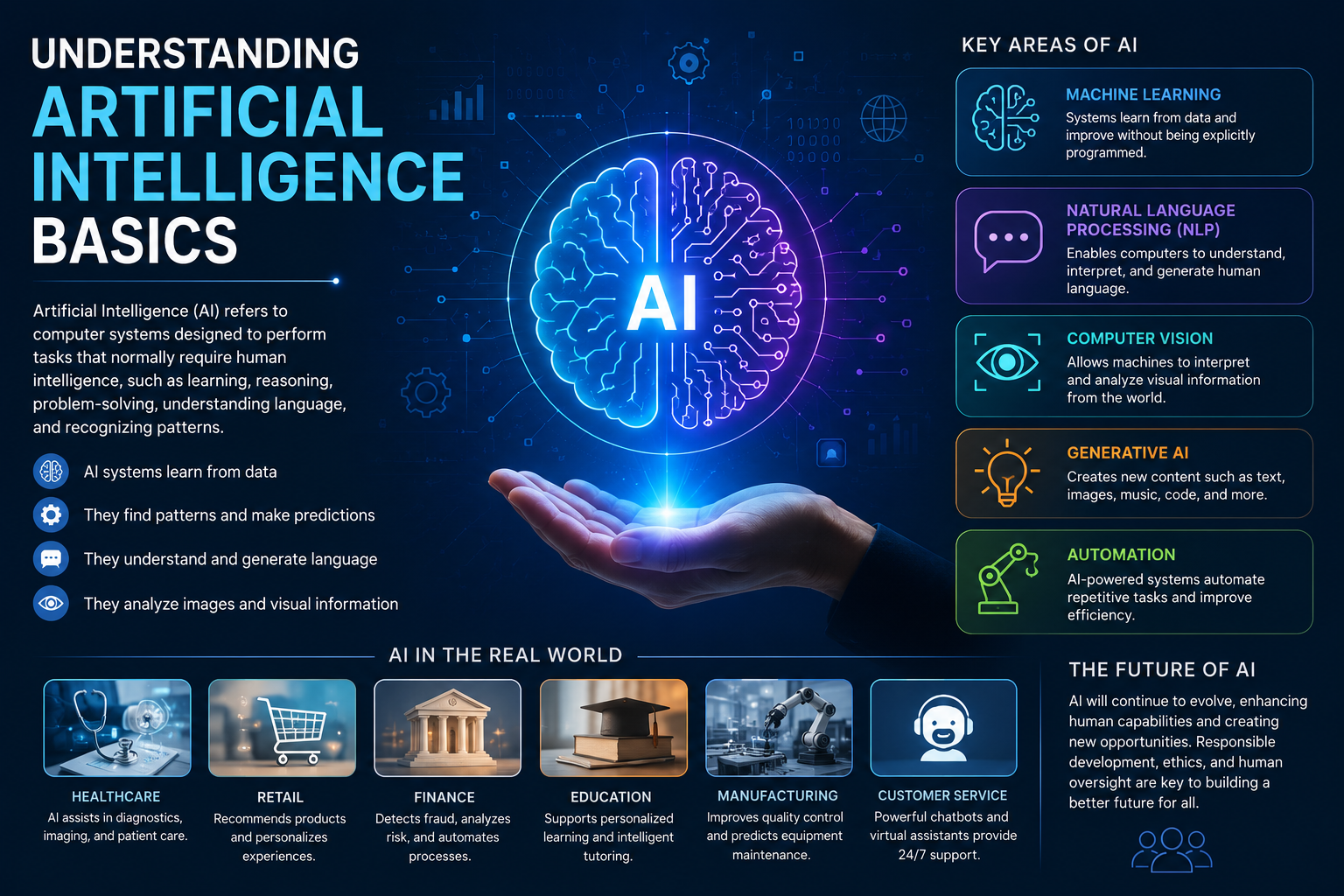
At its simplest level, artificial intelligence refers to computer systems designed to perform tasks that normally require human intelligence. These tasks may include learning, problem-solving, recognizing patterns, understanding language, making predictions, or generating content.
AI is not a single technology. It is a broad field containing multiple branches and methods.
One of the most common forms of AI today is machine learning. Machine learning allows systems to improve performance by analyzing data and identifying patterns.
Instead of being programmed with every specific rule, machine learning systems learn from examples.
For instance, a spam filter learns to recognize unwanted emails by analyzing large numbers of messages. Streaming platforms recommend movies by studying viewing behavior. Navigation apps predict traffic conditions using real-time data.
Another major area is natural language processing, often called NLP. This branch focuses on helping computers understand and generate human language.
Virtual assistants, chatbots, translation tools, and AI writing systems all rely heavily on natural language processing.
Computer vision is another important AI category. This involves teaching computers to interpret and analyze visual information.
Facial recognition systems, medical imaging analysis, self-driving vehicle sensors, and image classification tools all use computer vision technologies.
One reason AI has advanced rapidly in recent years is the availability of massive amounts of data combined with stronger computing power.
Modern AI systems can process enormous datasets far more efficiently than earlier generations of technology.
Deep learning, a more advanced subset of machine learning, has played a major role in recent breakthroughs. Deep learning uses layered neural networks inspired loosely by how the human brain processes information.
These systems excel at recognizing patterns in speech, images, video, and language.
Generative AI has also become increasingly popular. Generative AI systems can create new content such as text, images, music, code, and video.
Large language models, image generators, and AI-assisted creative tools are examples of generative AI applications.
While AI offers enormous potential, it also raises important questions and concerns.
One common misunderstanding is the belief that modern AI systems possess human consciousness or independent reasoning. Current AI systems are powerful pattern-recognition tools, but they do not think or feel like humans.
AI models generate outputs based on patterns learned from training data rather than genuine understanding.
Bias is another major concern. AI systems learn from human-created data, which means they can sometimes reflect existing biases or inaccuracies.
This is why responsible AI development requires careful testing, oversight, and transparency.
Privacy is also an important issue. Many AI systems rely on large datasets that may contain personal or behavioral information. Balancing innovation with ethical data practices remains a major challenge for governments, businesses, and technology developers.
Automation is another topic frequently associated with AI.
Some jobs may change significantly as AI tools become more capable of handling repetitive or data-driven tasks. However, AI is also expected to create new industries, roles, and opportunities.
Historically, technological change often shifts the nature of work rather than eliminating human involvement entirely.
Many businesses now use AI to improve efficiency, customer support, marketing analysis, logistics, and decision-making.
Healthcare organizations use AI to assist with diagnostics and medical imaging. Financial institutions use AI for fraud detection and risk analysis. Retailers use AI-powered recommendation systems to personalize shopping experiences.
Education is also being influenced by AI tools that support tutoring, content generation, language learning, and accessibility.
For individuals, understanding AI basics is becoming increasingly valuable because the technology is likely to continue expanding into everyday life.
You do not need to become a programmer or engineer to benefit from AI literacy. Understanding core concepts helps people make informed decisions about technology, privacy, careers, and digital tools.
One useful way to think about AI is as an amplifier. AI can increase productivity, automate repetitive work, and process information quickly. However, human judgment, creativity, ethics, and critical thinking remain extremely important.
AI works best when paired with thoughtful human oversight.
Businesses and professionals who learn how to use AI tools effectively may gain significant advantages in efficiency and content creation.
At the same time, overreliance on AI without human review can create problems related to accuracy, trust, and quality.
The future of AI will likely involve increasing collaboration between humans and intelligent systems.
As technology evolves, individuals who combine adaptability, creativity, communication skills, and technological understanding may be especially well positioned.
For beginners wanting to learn more about AI, starting with practical exploration is often helpful.
Experimenting with AI writing assistants, image generation tools, voice assistants, or productivity applications can provide hands-on understanding.
Learning basic concepts such as machine learning, data training, algorithms, and automation can also build a strong foundation.
Artificial intelligence is no longer a distant futuristic concept. It is already shaping communication, business, education, healthcare, entertainment, and daily decision-making.
Understanding the basics helps people navigate these changes with greater confidence rather than uncertainty.
The technology will continue evolving rapidly, but informed users will always be better prepared to adapt, evaluate opportunities, and make thoughtful choices in an increasingly AI-driven world.
Success in the digital age requires both knowledge and creativity. Build in-demand skills with Lead Academy and create professional-quality designs with CorelDRAW. Explore new possibilities and unlock your full potential today.