
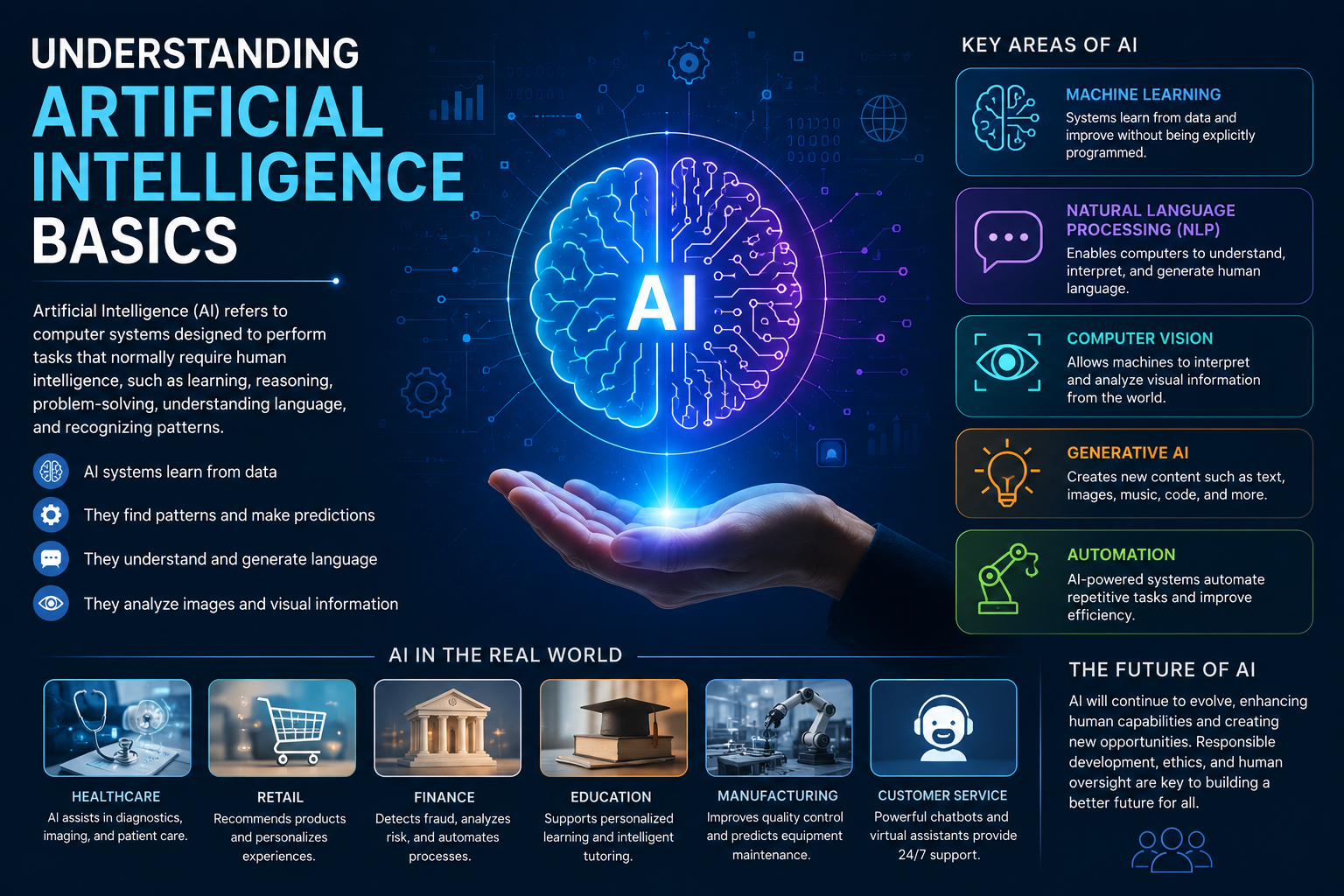
Generative artificial intelligence has rapidly become one of the most discussed technologies in the world. From AI chatbots and image generators to music composition and video creation, generative AI is transforming industries at an incredible pace.
Many people use generative AI tools daily without fully understanding how they work behind the scenes. While the technology is highly advanced, the core concepts can be explained in a relatively accessible way.
Generative AI refers to systems designed to create new content based on patterns learned from massive amounts of data.
This content can include:
- Text
- Images
- Audio
- Video
- Computer code
- Music
- Designs
Rather than simply retrieving stored information, generative AI produces original outputs based on learned relationships and probabilities.
The Foundation of Artificial Intelligence
At its core, artificial intelligence attempts to simulate certain aspects of human learning and decision-making.
Generative AI is powered primarily through machine learning, a branch of AI where systems learn patterns from data instead of being explicitly programmed for every task.
Traditional software follows fixed rules written by programmers.
Machine learning systems instead analyze enormous datasets to identify patterns, relationships, and structures.
What Training Data Does
Generative AI models are trained using massive datasets.
For text-based AI systems, this may include:
- Books
- Articles
- Websites
- Research papers
- Conversations
- Public documents
Image generators are trained using millions of labeled images.
During training, the model analyzes patterns repeatedly.
For example, a language model learns:
- Grammar
- Sentence structure
- Context
- Relationships between words
- Writing styles
- Common facts and concepts
It does not “think” like a human. Instead, it predicts likely outputs based on learned statistical relationships.
Understanding Neural Networks
Most modern generative AI systems use neural networks.
Neural networks are loosely inspired by the human brain, though they operate very differently.
These systems contain layers of interconnected mathematical nodes that process information.
As data moves through the network, the model adjusts internal parameters to improve accuracy.
Modern AI models may contain billions or even trillions of parameters.
These parameters help the system determine probabilities and relationships between pieces of information.
How Large Language Models Work
Chatbots and writing assistants often rely on Large Language Models, commonly called LLMs.
LLMs are trained to predict the next word or token in a sequence.
For example, if given the phrase:
“The sky is…”
The model predicts likely next words such as:
- blue
- cloudy
- clear
The prediction process becomes extremely sophisticated when dealing with larger contexts and more complex instructions.
LLMs analyze patterns across huge datasets to generate coherent responses.
Although responses may appear intelligent, the model is fundamentally performing advanced probability prediction.
The Role of Tokens
AI language models process text as tokens rather than complete sentences.
Tokens may represent:
- Words
- Parts of words
- Symbols
- Punctuation
The model predicts tokens step by step to generate responses.
This prediction process happens extremely quickly using powerful computing infrastructure.
What Makes Generative AI Different
Traditional AI systems often focused on classification or prediction.
Examples include:
- Spam filters
- Recommendation engines
- Fraud detection
- Facial recognition
Generative AI goes further by creating entirely new outputs.
An image generator can create artwork that never previously existed.
A music generator can compose new melodies.
A language model can write essays, scripts, or code.
This creative capability is what makes generative AI so transformative.
How Image Generation Works
AI image generators typically use models trained on millions of images paired with text descriptions.
The system learns relationships between visual elements and language.
When someone enters a prompt like:
“A futuristic city at sunset”
The model generates an image by predicting visual patterns associated with those concepts.
Many modern image generators use diffusion models.
These systems start with random noise and gradually refine it into a coherent image based on learned patterns.
Reinforcement Learning and Fine-Tuning
Many generative AI systems improve through reinforcement learning and fine-tuning.
Human reviewers may evaluate outputs and provide feedback.
This feedback helps align models with:
- Accuracy
- Safety
- Helpfulness
- Ethical guidelines
Fine-tuning allows models to specialize in certain tasks or industries.
For example, some AI systems are fine-tuned for:
- Medical analysis
- Legal research
- Customer service
- Programming assistance
- Educational support
Limitations of Generative AI
Despite impressive capabilities, generative AI has important limitations.
AI systems can:
- Produce inaccurate information
- Generate biased outputs
- Misunderstand context
- Hallucinate facts
- Reflect training data limitations
Generative AI does not possess true understanding, consciousness, or human reasoning.
It predicts outputs based on patterns rather than genuine comprehension.
This is why human oversight remains essential.
Ethical and Societal Concerns
The growth of generative AI raises major ethical and societal questions.
Important concerns include:
- Copyright issues
- Misinformation
- Deepfakes
- Privacy risks
- Job displacement
- Bias in training data
- Security threats
Governments, businesses, educators, and researchers continue debating how AI should be regulated and responsibly deployed.
The Future of Generative AI
Generative AI will likely continue expanding across nearly every industry.
Potential future applications include:
- Personalized education
- Advanced healthcare diagnostics
- Automated content creation
- Enhanced software development
- Scientific research acceleration
- Improved accessibility tools
As models become more capable, the balance between automation and human creativity will become increasingly important.
Final Thoughts on Generative AI
Generative AI represents a major technological shift that is reshaping communication, creativity, and productivity.
At its foundation, generative AI works by learning patterns from enormous datasets and using statistical prediction to create new outputs.
While the technology may seem almost magical at times, it ultimately relies on mathematics, computing power, and large-scale data analysis.
Understanding how generative AI works helps people use these tools more responsibly, critically, and effectively.
The technology will continue evolving rapidly, making AI literacy an increasingly valuable skill in the modern world.