
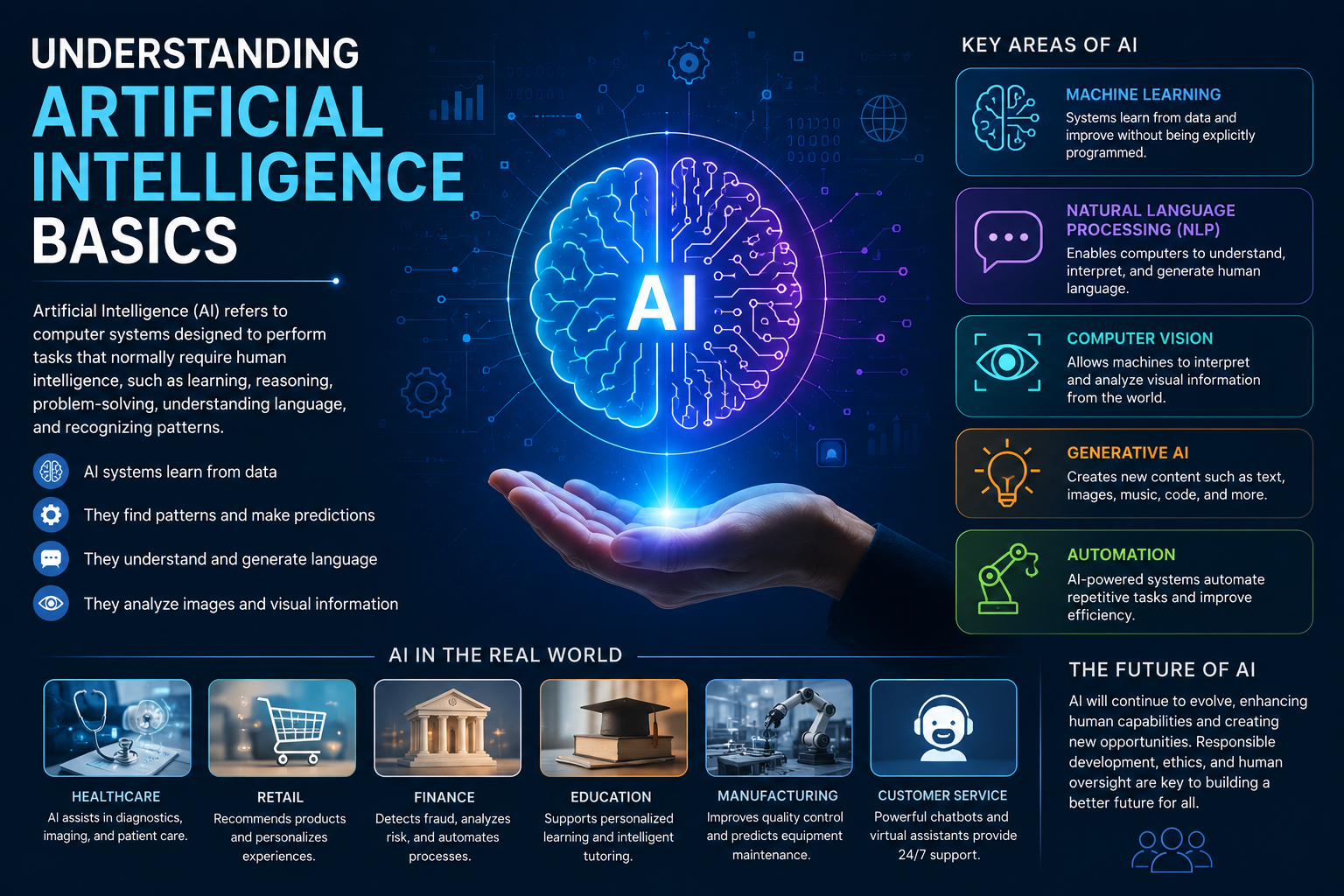
Computer vision, one of the most fascinating fields in artificial intelligence (AI), enables machines to "see" and interpret the visual world, much like humans do. This revolutionary technology powers everything from facial recognition and self-driving cars to medical imaging and augmented reality. But how does it actually work? Let us break down the mechanics behind computer vision and explore how it functions within AI applications.
What Is Computer Vision?
At its core, computer vision is a branch of AI that focuses on enabling machines to process, analyze, and understand visual information like images or videos and make decisions based on that data. Think of it as teaching a computer to not just see an apple in a photo but also recognize that it is red, round, and a fruit.
While humans interpret visual information effortlessly, replicating this ability in machines requires advanced algorithms, vast amounts of data, and powerful computational resources.
The Building Blocks of Computer Vision
Computer vision involves several key components that work together to achieve its goals:
1. Image Acquisition
The process begins with capturing visual data. This could be a static image, a sequence of video frames, or live footage from a camera. The input serves as the raw material for further analysis.
- Examples of image sources: cameras, medical scanners, satellites, or even user-uploaded photos.
- Formats: Images might come in formats like JPEG, PNG, or as pixel data for deeper processing.
2. Preprocessing
Before analyzing the image, the raw data often undergoes preprocessing to enhance its quality and make it easier for algorithms to process.
- Noise Reduction: Filters are applied to remove unwanted visual noise.
- Resizing and Cropping: Images are adjusted to standard dimensions suitable for models.
- Normalization: Pixel values are scaled to ensure consistency across the dataset.
3. Feature Extraction
Feature extraction identifies patterns and key characteristics within an image. For instance:
- Edges, corners, and shapes.
- Color histograms and textures.
- Specific patterns like faces or objects.
Earlier computer vision systems relied heavily on manually engineered features. Modern systems, powered by deep learning, automatically learn and extract features using neural networks.
How AI Powers Computer Vision
AI, particularly machine learning (ML) and deep learning, has propelled computer vision to new heights. Here is how these technologies contribute:
1. Machine Learning
Traditional computer vision methods relied on ML algorithms like Support Vector Machines (SVM) and k-Nearest Neighbors (k-NN). These required manually crafted features and statistical models to classify images or detect objects.
Example: Training an ML model to distinguish between cats and dogs by providing labeled examples and manually selected features like fur texture or ear shape.
2. Deep Learning
Deep learning, a subset of ML, uses artificial neural networks to analyze images in a more complex and accurate way. Convolutional Neural Networks (CNNs) are the backbone of modern computer vision.
- What Are CNNs? CNNs mimic the human brain's visual processing system. They consist of multiple layers that process images hierarchically, starting from simple patterns (e.g., edges) and progressing to complex features (e.g., faces or objects).
- How It Works:
- Convolution Layers: Detect patterns like edges and textures.
- Pooling Layers: Reduce the spatial size of feature maps, improving computational efficiency.
- Fully Connected Layers: Combine extracted features to classify or identify objects.
- Convolution Layers: Detect patterns like edges and textures.
- Pooling Layers: Reduce the spatial size of feature maps, improving computational efficiency.
- Fully Connected Layers: Combine extracted features to classify or identify objects.
Example: In facial recognition, CNNs might first identify eyes, noses, and mouths, then combine these features to recognize a specific individual.
3. Training with Data
AI models require large datasets to learn effectively. For computer vision:
- Datasets include labeled images, such as ImageNet, COCO, or custom datasets tailored to specific use cases.
- Models are trained using these datasets, learning to recognize patterns, objects, or features through repeated exposure.
Key Applications of Computer Vision
Computer vision is already making waves across industries. Here are a few noteworthy applications:
1. Facial Recognition
- Used in smartphones (Face ID), security systems, and social media tagging.
- Algorithms analyze facial features, such as the distance between eyes or the shape of the jawline, to match individuals.
2. Object Detection
- Powers autonomous vehicles by identifying pedestrians, road signs, and other vehicles.
- Retail systems use object detection for inventory management and cashierless checkout.
3. Image Segmentation
- Splits an image into segments to identify objects and their boundaries.
- Critical for medical imaging (e.g., detecting tumors in scans).
4. Augmented Reality (AR)
- AR apps overlay digital content on the real world by recognizing and interpreting surroundings.
- Examples: Snapchat filters, Pokémon GO, and virtual furniture placement.
5. Healthcare Diagnostics
- AI systems analyze medical images like X-rays or MRIs to detect anomalies, such as fractures or diseases.
6. Manufacturing Quality Control
- Vision systems inspect products for defects during production.
Challenges in Computer Vision
Despite its advancements, computer vision faces several challenges:
- Data Dependence: High-quality labeled datasets are crucial but often expensive and time-consuming to create.
- Variability in Inputs: Changes in lighting, angles, or occlusions can affect accuracy.
- Real-Time Processing: Some applications, like autonomous driving, require processing visual data instantaneously.
- Bias and Fairness: AI models trained on unbalanced datasets may inherit biases, leading to inaccuracies in specific demographics.
The Future of Computer Vision
The field is rapidly evolving, with advancements poised to make computer vision even more powerful.
- 3D Vision: Systems that understand depth and spatial relationships (e.g., LiDAR for self-driving cars).
- Multimodal AI: Integrating visual data with text, audio, or other inputs for richer insights.
- Edge Computing: Deploying vision systems on devices (like drones or IoT sensors) for faster processing.
Computer vision combines cutting-edge AI techniques, advanced algorithms, and massive data processing to give machines the ability to "see." From recognizing faces to driving cars, its applications are reshaping industries and daily life. While challenges remain, the continuous development of AI tools and techniques ensures computer vision will only become more sophisticated and impactful in the years to come.
Whether you are a tech enthusiast, developer, or business leader, understanding how computer vision works opens doors to leveraging this transformative technology for innovation and growth.