
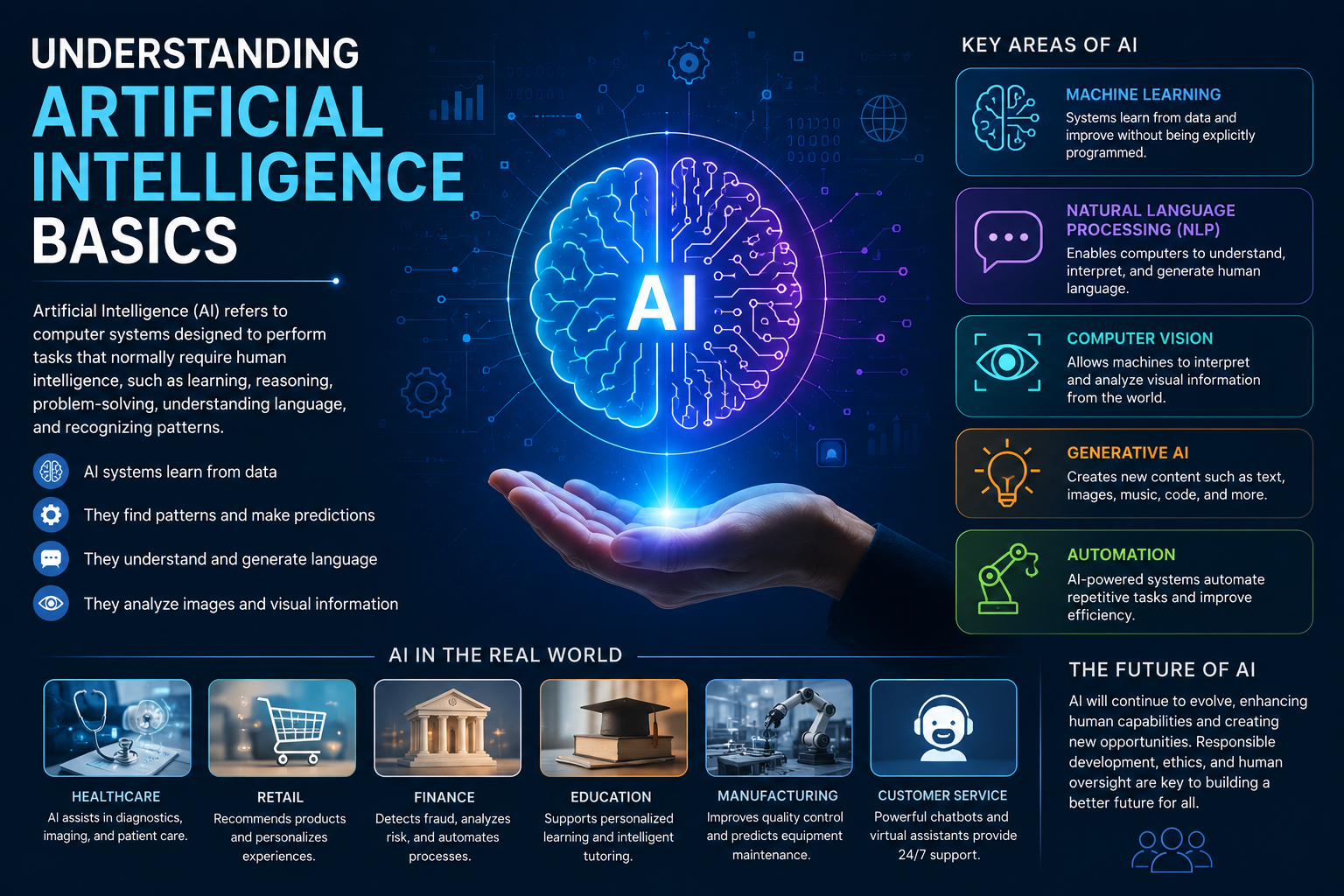
Artificial intelligence has become one of the most talked-about technologies in modern society. AI tools now assist with writing, coding, customer service, research, image creation, automation, and countless other tasks.
Despite rapid adoption, many misconceptions about AI continue to spread online. These myths often create unnecessary fear, unrealistic expectations, or confusion for beginners trying to understand the technology.
Separating facts from fiction is important because AI is likely to play an increasingly significant role in business, education, healthcare, and daily life.
Myth 1: AI Thinks Like Humans
One of the most common misconceptions is that AI systems think or reason like humans.
In reality, most AI systems do not possess consciousness, emotions, self-awareness, or true understanding.
AI models analyze patterns in data and generate outputs based on probabilities.
For example, language models predict likely word sequences based on patterns learned during training.
Although responses may appear intelligent, the system is not “thinking” in the same way humans do.
Myth 2: AI Always Gives Correct Answers
Many beginners assume AI tools are always accurate.
This is not true.
AI systems can:
- Generate false information
- Misunderstand prompts
- Produce biased outputs
- Invent facts
- Misinterpret context
This issue is sometimes called “hallucination.”
AI-generated content should often be reviewed and verified, especially for:
- Medical information
- Financial advice
- Legal topics
- Academic research
Human oversight remains essential.
Myth 3: AI Will Immediately Replace All Jobs
Fear of mass job replacement is widespread.
While AI will certainly automate some tasks, most experts believe the impact will be more complex.
Historically, technological advances often:
- Eliminate certain jobs
- Transform existing roles
- Create entirely new industries
AI is more likely to change how people work rather than instantly eliminate all employment.
Many jobs will increasingly involve collaboration between humans and AI systems.
Myth 4: AI Is Completely Objective
Some people believe AI systems are neutral and unbiased.
However, AI models learn from human-created data.
If training data contains bias, misinformation, or imbalances, AI outputs may reflect those issues.
Bias can appear in:
- Hiring systems
- Facial recognition
- Search algorithms
- Recommendation engines
- Language models
Developers actively work to reduce bias, but no system is completely perfect.
Myth 5: AI Understands Emotions
AI can simulate emotionally intelligent responses, but this does not mean it experiences emotions.
A chatbot may produce empathetic language because it has learned patterns associated with supportive communication.
This differs significantly from genuine human emotional experience.
Understanding this distinction is important when interacting with AI systems.
Myth 6: AI Is Only for Tech Experts
Many beginners believe AI requires advanced programming knowledge.
While AI development can be highly technical, modern AI tools are increasingly accessible.
Today, many people use AI for:
- Writing assistance
- Image generation
- Study support
- Brainstorming
- Research
- Productivity
- Marketing
User-friendly interfaces allow nontechnical users to benefit from AI without understanding complex programming.
Myth 7: AI Is Brand New
Although generative AI recently exploded in popularity, AI research has existed for decades.
Artificial intelligence concepts date back to the mid-20th century.
Earlier forms of AI already powered:
- Search engines
- Spam filters
- Recommendation systems
- Voice assistants
- Fraud detection
Modern generative AI represents a major advancement, but it builds upon years of prior research.
Myth 8: More Data Always Means Better AI
Large datasets are important, but quality matters as much as quantity.
Poor-quality training data can lead to:
- Inaccurate outputs
- Increased bias
- Lower reliability
- Confusing responses
Effective AI systems depend on carefully designed training methods and ongoing refinement.
Myth 9: AI Is Fully Autonomous
Many AI systems still require substantial human involvement.
Humans often:
- Train models
- Review outputs
- Fine-tune performance
- Monitor safety
- Set objectives
- Correct errors
AI systems are tools created and guided by human decisions.
Myth 10: AI Is Either Good or Bad
Public discussions about AI often become overly extreme.
Some portray AI as a miracle solution to every problem.
Others describe it as an existential threat.
In reality, AI is a tool.
Its impact depends largely on:
- How it is designed
- How it is regulated
- How responsibly it is used
- Who controls access
Like many technologies, AI has both opportunities and risks.
Why AI Literacy Matters
As AI becomes more integrated into society, understanding its strengths and limitations becomes increasingly important.
AI literacy helps people:
- Use tools more effectively
- Recognize misinformation
- Avoid unrealistic expectations
- Make informed decisions
- Adapt to changing industries
Even basic understanding can significantly improve how people interact with emerging technologies.
Final Thoughts on AI Myths
Artificial intelligence is powerful, but it is often misunderstood.
Many myths arise from exaggerated media coverage, science fiction influences, or unrealistic assumptions about what AI can actually do.
Understanding the reality behind AI helps beginners approach the technology with a balanced perspective.
Rather than viewing AI as magic or catastrophe, it is more useful to see it as a rapidly evolving tool with significant potential and important limitations.
The more informed people become about AI, the better prepared they will be for the future.