
How People Learn More Effectively
This week’s article brought to you by Scrivener and LearnTastic Solutions
Education & E Learning:
Learning is a lifelong process, yet many people never receive formal instruction on how learning works.
Students, professionals, entrepreneurs, and lifelong learners often spend years relying on ineffective study habits simply because those methods feel familiar.
Understanding how people learn more effectively can dramatically improve retention, skill development, productivity, and confidence.
One of the biggest misconceptions about learning is the belief that intelligence is fixed.
Research consistently shows that the brain remains adaptable throughout life. Skills improve through practice, repetition, feedback, and exposure.
This concept, often called a growth mindset, encourages people to view challenges as opportunities for development rather than evidence of limitation.
Effective learning begins with attention.
Modern environments are filled with distractions: smartphones, notifications, multitasking, social media, and constant information overload.
Deep learning requires focus.
When attention is fragmented, comprehension and memory retention decline significantly.
Creating distraction-free learning periods can dramatically improve efficiency.
Short, focused sessions are often more effective than long periods of distracted study.
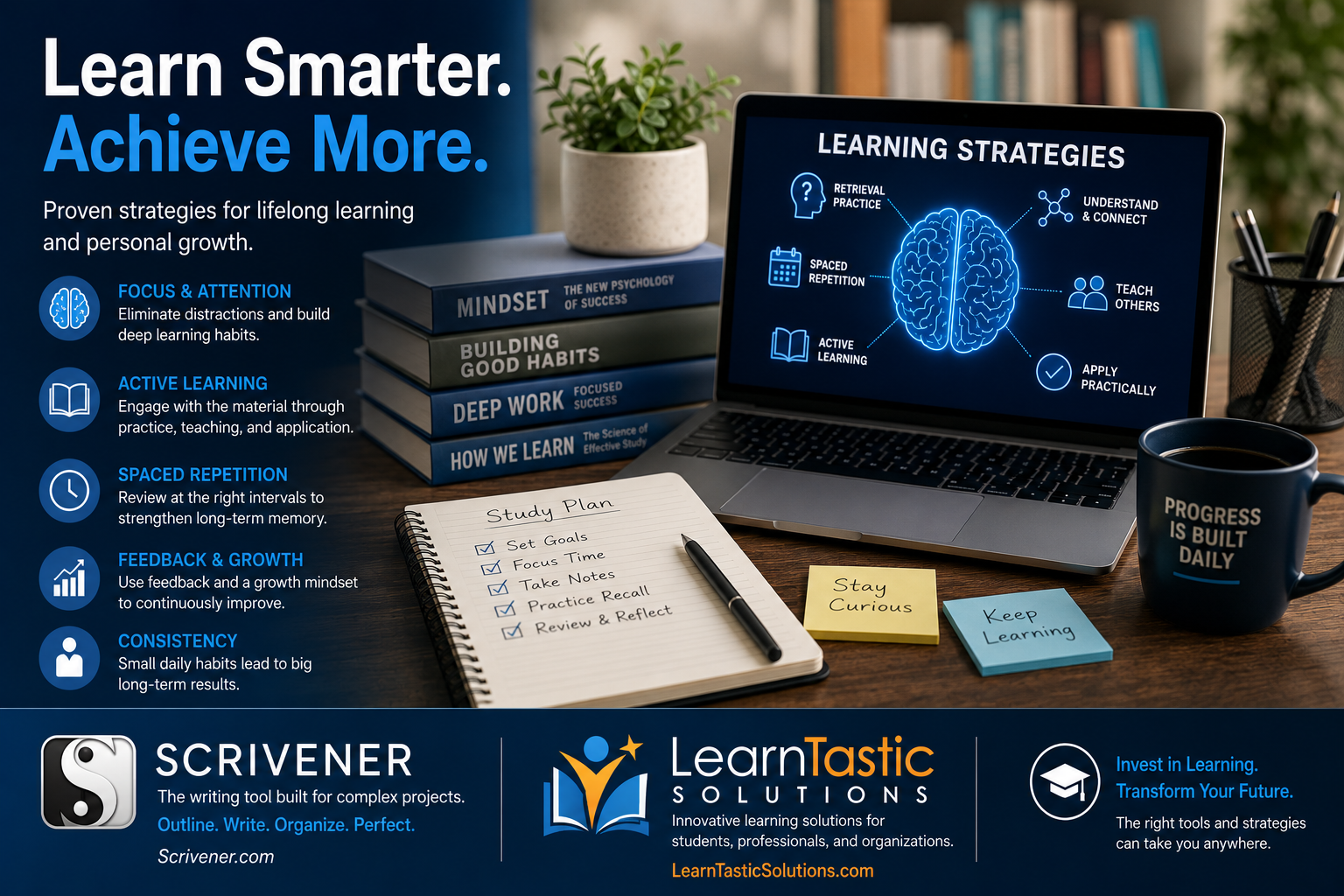
Another important principle is active learning.
Many people rely heavily on passive methods such as rereading notes or highlighting textbooks. While these techniques may feel productive, they often produce weak retention.
Active learning requires engagement.
Examples include:
- Practicing recall without notes
- Teaching concepts to others
- Solving problems
- Writing summaries in your own words
- Applying information practically
Retrieval practice is especially powerful.
Actively recalling information strengthens memory far more effectively than simply reviewing material repeatedly.
For example, testing yourself on concepts without looking at notes forces the brain to retrieve information, reinforcing neural connections.
Spaced repetition is another highly effective learning strategy.
Instead of cramming information into a single session, spaced repetition spreads review sessions over time.
This method improves long-term retention because the brain strengthens memories through repeated exposure at strategic intervals.
Sleep also plays a critical role in learning.
During sleep, the brain consolidates information and strengthens memory pathways.
Poor sleep reduces concentration, retention, and problem-solving ability.
Many people underestimate how strongly physical health affects cognitive performance.
Exercise, hydration, nutrition, and stress management all influence learning capacity.
Movement increases blood flow to the brain and can improve focus and mood.
Stress management is equally important because chronic stress interferes with memory formation and concentration.
Another common mistake is confusing familiarity with mastery.
Simply recognizing information while reading does not mean you truly understand it.
Real understanding becomes clear when you can explain concepts clearly, apply them in new situations, or solve problems independently.
Learning also improves when information is connected to existing knowledge.
The brain organizes information through associations and patterns.
When new ideas connect to previous experiences or concepts, retention becomes stronger.
This is why analogies, storytelling, and practical examples often improve comprehension.
Curiosity plays a major role as well.
People learn more effectively when genuinely interested in a subject.
Motivation increases attention, persistence, and engagement.
Finding personal relevance within a topic can make difficult material easier to absorb.
Environment matters too.
Consistent study locations, organized workspaces, and reduced distractions can improve mental focus.
Some learners benefit from quiet spaces, while others prefer background music or ambient noise.
Understanding your personal learning preferences can improve consistency.
However, it is important not to overemphasize “learning styles” in simplistic ways.
While people may have preferences, effective learning usually involves multiple methods such as reading, listening, discussion, visual examples, and hands-on practice.
Technology has also transformed learning opportunities.
Online courses, educational videos, digital libraries, podcasts, and AI-powered learning tools provide access to information at unprecedented levels.
The challenge today is often not access to information but filtering and organizing it effectively.
Critical thinking has therefore become increasingly important.
Effective learners evaluate sources carefully, question assumptions, compare viewpoints, and seek evidence.
Memorization alone is no longer enough in many fields.
Adaptability and problem-solving are becoming more valuable skills in rapidly changing environments.
Feedback is another essential part of learning.
Constructive feedback helps identify weaknesses, improve performance, and accelerate growth.
Many people avoid feedback because criticism feels uncomfortable, but effective learners use feedback as a tool for improvement.
Consistency often matters more than intensity.
Small daily learning sessions frequently outperform occasional marathon study sessions.
Habits create momentum.
Reading a few pages daily, practicing skills regularly, or reviewing material consistently builds long-term progress.
Teaching others is also one of the strongest ways to reinforce learning.
Explaining concepts clearly forces deeper understanding and reveals knowledge gaps.
This is why discussion groups, mentoring, and collaborative learning environments can be highly effective.
Mindset remains one of the most powerful factors in learning success.
People who believe abilities can improve through effort are more likely to persist through challenges.
Fear of failure often prevents growth.
Mistakes are not signs of inability. They are part of the learning process.
One practical approach to improving learning effectiveness includes:
- Reducing distractions during study sessions
- Using active recall methods
- Reviewing material with spaced repetition
- Prioritizing sleep and health
- Applying concepts practically
- Seeking feedback consistently
- Learning in smaller, consistent sessions
These principles apply across nearly every field, from academics and business to creative skills and personal development.
The ability to learn effectively is becoming increasingly valuable in a world where industries, technologies, and information evolve rapidly.
People who develop strong learning habits are often better prepared to adapt, grow, and succeed throughout life.
Learning is not simply about gathering information. It is about building understanding, improving skills, and expanding the ability to think critically and solve problems.
When people understand how learning works, they can approach growth with greater confidence, efficiency, and long-term success.
Turn knowledge into results. Create, organize, and write more effectively with Scrivener and expand your skills with the educational resources and training solutions available through LearnTastic Solutions.