
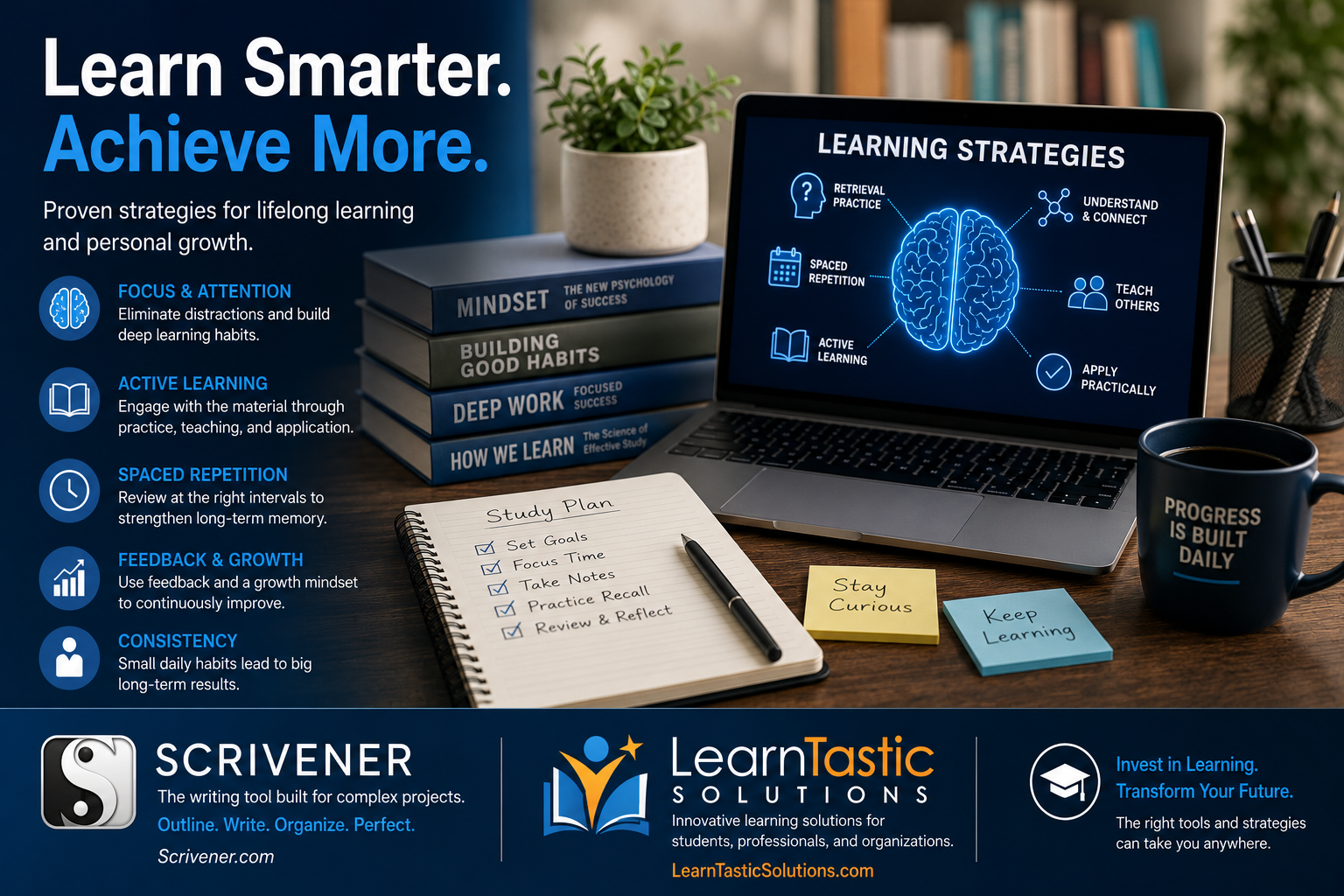
Learning is not simply about spending time with information. The methods people use to study often determine how well they actually understand and retain knowledge.
Many students rely heavily on passive learning techniques without realizing that more active approaches are often significantly more effective.
Understanding the difference between active and passive learning can improve academic performance, memory retention, and long-term skill development.
What Is Passive Learning?
Passive learning occurs when students absorb information without significant engagement or interaction.
Common passive learning activities include:
- Reading textbooks repeatedly
- Highlighting notes excessively
- Watching lectures without participation
- Listening without taking action
- Reviewing material without self-testing
Passive learning may feel productive because it is comfortable and familiar.
However, passive exposure alone often creates the illusion of learning rather than deep understanding.
What Is Active Learning?
Active learning involves directly engaging with material through participation, problem-solving, recall, or application.
Examples include:
- Practice testing
- Teaching concepts to others
- Solving problems
- Creating summaries from memory
- Participating in discussions
- Applying concepts to real scenarios
- Writing explanations in one’s own words
Active learning forces the brain to retrieve and process information more deeply.
Why Active Learning Works Better
Research consistently shows that active learning improves retention and comprehension.
When students actively retrieve information, stronger neural connections form.
This process strengthens memory and improves the ability to apply knowledge later.
Passive review may create familiarity, but familiarity is not the same as mastery.
The Problem with Rereading
Many students reread textbooks or notes repeatedly.
While rereading can have some value, it often becomes inefficient when used alone.
Students may recognize information visually without actually being able to recall or explain it independently.
This false sense of confidence can become problematic during exams.
Retrieval Practice and Memory
One of the most effective active learning strategies is retrieval practice.
This involves recalling information from memory without immediately looking at notes.
Examples include:
- Flashcards
- Practice quizzes
- Self-testing
- Writing answers from memory
Retrieval strengthens long-term memory significantly more than passive review.
Spaced Repetition
Active learning becomes even more effective when combined with spaced repetition.
Spaced repetition involves reviewing material over increasing intervals of time.
This method improves retention while reducing the need for cramming.
Apps like Anki and Quizlet often use spaced repetition systems.
The Role of Discussion and Teaching
Explaining concepts to others is a powerful active learning technique.
Teaching forces students to:
- Organize information
- Identify gaps in understanding
- Simplify complex ideas
- Strengthen recall
If someone can clearly teach a concept, they usually understand it well.
Problem-Based Learning
Applying information through practice is another important form of active learning.
Examples include:
- Solving math problems
- Writing essays
- Conducting experiments
- Practicing coding
- Using case studies
Application builds practical understanding rather than simple memorization.
Active Learning and Attention
Active learning also improves focus.
Passive activities often allow the mind to wander.
Active engagement requires concentration and participation, making study sessions more mentally stimulating.
Why Passive Learning Still Exists
Passive learning remains popular because it feels easier and less mentally demanding.
Watching lectures or rereading notes can create comfort without requiring much effort.
Unfortunately, effective learning often requires cognitive struggle.
That struggle is part of what strengthens memory and understanding.
Combining Both Approaches
Passive learning is not entirely useless.
Reading, listening, and watching educational material still provide valuable exposure to information.
However, passive learning works best when combined with active methods.
For example:
- Read the chapter
- Summarize key ideas from memory
- Take a practice quiz
- Explain concepts aloud
- Apply the material through exercises
This combination improves both understanding and retention.
Active Learning Beyond School
Active learning is valuable beyond formal education.
Professionals use active learning to:
- Build job skills
- Learn software
- Improve communication
- Develop technical expertise
- Master creative disciplines
Lifelong learning becomes more effective when people actively engage with information.
Final Thoughts on Learning Strategies
The difference between active and passive learning can significantly impact educational success.
While passive review may feel easier, active learning methods typically produce stronger retention, deeper understanding, and better long-term results.
Students who practice retrieval, application, discussion, and spaced repetition often learn more efficiently than those who rely solely on rereading or passive review.
Learning is not just about exposure to information. True learning happens when the brain actively processes, recalls, and applies knowledge over time.